- Zero-RGB Symbolic 3D /tf Grounding: Disabling Isaac Sim Replicator RGB camera capture (
latest_rgb = None,0image tokens) and feeding 50 Hz 3D/tfposes intoRuleBasedTaskGeneratorandRuleBasedTaskVerifierachieved 100% (9/9) multi-robot tower assembly with zero collisions across all three stages. - Hybrid Brain-Executor Routing (-76.6% API Cost): Invoking
gemini-4-argononce on Turn 0 (thinking_budget=256) to synthesize the global schedule and delegating Turns 1–10 togemini-3.5-flash-lite(thinking_budget=0) reduced trial cost from$0.08437to$0.01972and lowered early-turn step latency from13.31 sto4.17 s(-68.7%). - Software-Pipelined Multi-Arm Interleaving (10 vs. 13 Turns): Whereas
gemini-robotics-er-2-previewstalled at wave-locked barriers (13 turns, 50,190 tokens),gemini-4-argonoverlapped outer-tablepickandgo_homeactions with central-towerplacemotions from Turn 3 onward, finishing in 10 turns and avoiding 10,929 quadratic history tokens.
Rethinking Visual Tokens in Closed-Loop Multi-Arm Manipulation
A common assumption in Vision-Language-Action (VLA) system design is that high-level task planners must continuously ingest multi-view RGB camera frames at every decision step. In multi-manipulator simulation and industrial workcells, however, streaming high-resolution base64 images on every turn introduces two compounding bottlenecks: it forces the physics simulator to run expensive GPU render-product pipelines (such as NVIDIA Isaac Sim Replicator viewports), and it appends thousands of visual tokens to a conversation history that grows quadratically with episode length.
In M9G's IsaacSim_GeminiRobotics testbed (Mode 1, three_robot_tower.py), three 7-DoF Franka Emika FR3 manipulators (FR3_1, FR3_2, FR3_3) surround a shared central stacking platform at [0.0, 0.0] while drawing from three outer source tables holding nine numbered blocks (B1..B9). Rather than passing overhead RGB frames (latest_rgb = None, --enable-cameras disabled), our closed-loop controller grounds the LLM strictly on 50 Hz 3D /tf transforms (WorkspaceState), a deterministic spatial blueprint synthesized by RuleBasedTaskGenerator, and a pre-execution kinematic and ownership shield (RuleBasedTaskVerifier) driving a 50 Hz damped least-squares (DLS) inverse kinematics controller over FastDDS unicast.
Decoupling Strategic Synthesis from Deterministic Step Execution
To isolate the impact of frontier reasoning versus step-execution latency, GeminiRoboticsNode._run_automated_comparison_workflow() executes a continuous three-stage hardware-in-the-loop protocol inside a single simulation process. Between stages, the node publishes Empty() to /reset_simulation, restoring all nine blocks to Tables 1–3 and homing FR3_1..3 across a 4.0-second mechanical settle window:
- Stage 1 — Legacy Homogeneous VLA Loop (
gemini-robotics-er-2-preview): Usesgemini-robotics-er-2-previewfor both Turn-0 strategy generation (thinking_budget=256) and every subsequent tool-dispatch turn (thinking_budget=512). - Stage 2 — Pure Frontier Reasoning Loop (
gemini-4-argon): Runsgemini-4-argonon Turn 0 (thinking_budget=256) and across all step turns (thinking_budget=512) to measure the scheduling gain of frontier reasoning and its raw step-latency cost. - Stage 3 — Hybrid Brain-Executor Routing (
1x gemini-4-argon+10x gemini-3.5-flash-lite): Invokesgemini-4-argonstrictly once on Turn 0 (thinking_budget=256) to synthesize the 10-turn software-pipelined schedule, then delegates Turns 1–10 togemini-3.5-flash-litewiththinking_budget=0, escalating back to Argon only if a pick fault orRuleBasedTaskVerifierrejection occurs.
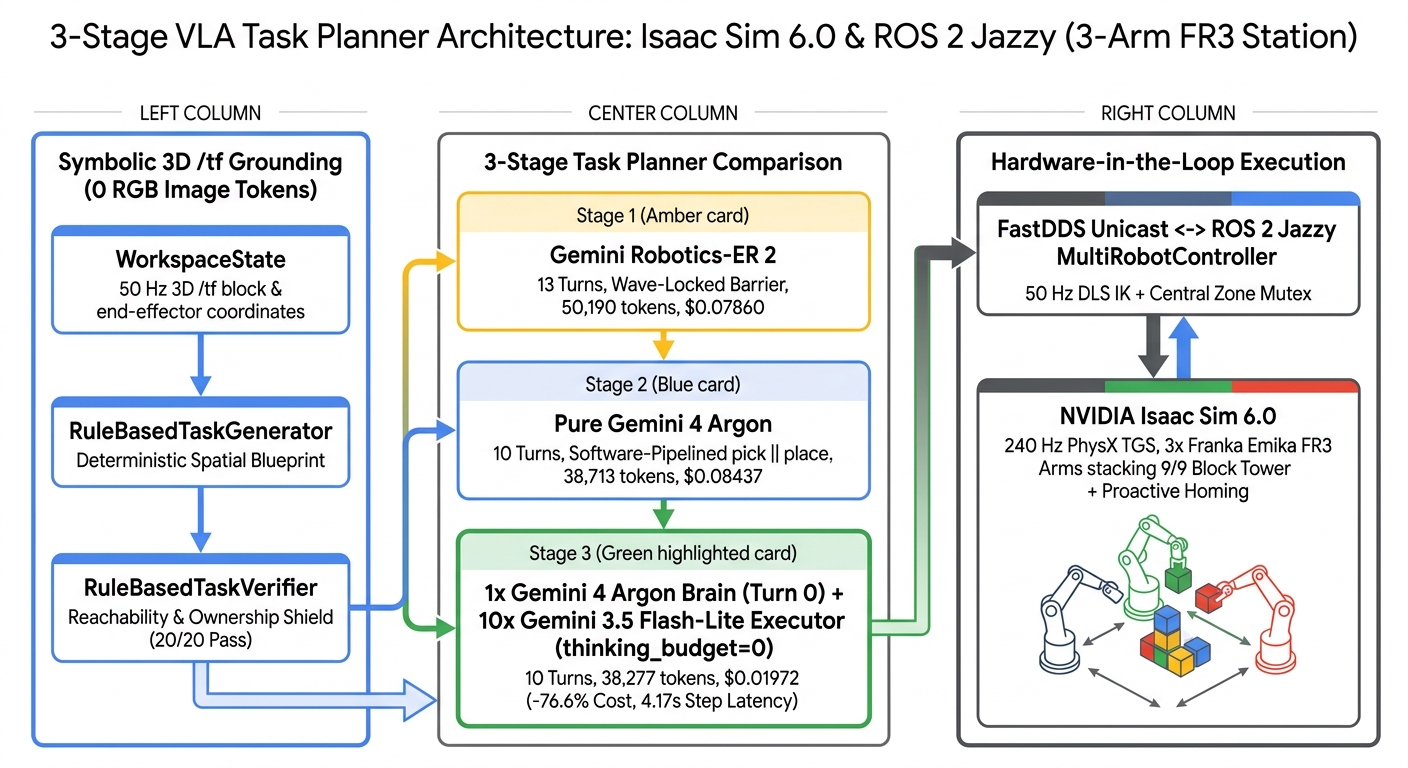
Empirical Telemetry Across the Three-Stage Evaluation
All three stages achieved 100% task completion (9/9 blocks stacked on the central tower) and a 100% pre-execution safety verifier pass rate, confirming that symbolic 3D /tf grounding suffices for collision-free multi-arm coordination. However, the three architectures differed sharply in schedule horizon, step latency, and API cost:
| System Telemetry Metric | Stage 1: Legacy ER-2 | Stage 2: Pure Argon | Stage 3: M9G Hybrid (1A + 10F) |
|---|---|---|---|
| Visual Input Modality | 0 RGB tok (3D /tf) | 0 RGB tok (3D /tf) | 0 RGB tok (3D /tf) |
| Turn-0 Strategic Brain Model | gemini-robotics-er-2-preview | gemini-4-argon | gemini-4-argon (1 call) |
| Turns 1..N Step Executor Model | gemini-robotics-er-2-preview | gemini-4-argon | gemini-3.5-flash-lite (10 calls) |
| Turn-0 / Step Thinking Budget | 256 / 512 tok | 256 / 512 tok | 256 / 0 tok (Disabled on steps) |
| Execution Horizon & API Calls | 13 turns (14 calls) | 10 turns (11 calls) | 10 turns (11 calls) |
| Cumulative Input Tokens | 48,377 | 37,845 (-21.8%) | 37,448 (-22.6%) |
| Thinking / Output Action Tokens | 1,086 / 727 | 0 / 868 | 0 / 829 |
| Total Episode Tokens | 50,190 | 38,713 (-22.9%) | 38,277 (-23.7%) |
| Turn-0 Brain Synthesis Latency | 1,987 ms | 8,870 ms | 4,670 ms (-47.4%) |
| Turns 1–2 Mean Step Latency | 2.58 s | 13.31 s | 4.17 s (-68.7%) |
| Tower Completion & Verifier Pass | 9/9 blk | 19/19 (100%) | 9/9 blk | 20/20 (100%) | 9/9 blk | 20/20 (100%) |
| Multi-Arm Workload Gini Index | 0.0351 (6, 7, 6) | 0.0342 (7, 7, 6) | 0.0339 (7, 7, 6) |
| Total Trial Cost ($ USD) | $0.07860 | $0.08437 | $0.01972 (-76.6%) |
Quadratic Context Accumulation & Thinking-Budget Economics
Even with camera streams disabled, input tokens represent 96.4% to 97.8% of total token volume across all three stages. Each turn transmits a static base context B_base ≈ 2,800 tokens—comprising SYSTEM_PROMPT and ROBOT_TOOLS JSON schemas (~1,450 tokens) plus the Turn-0 RuleBasedTaskGenerator 3D blueprint and strategy (~1,350 tokens)—alongside a rolling increment ΔB_turn ≈ 250–380 tokens of multi-turn function_call and controller function_response records. Re-sending the rolling conversation history on every turn yields quadratic input growth with respect to horizon T:
Compressing the schedule from 13 turns (Stage 1) to 10 turns (Stages 2 and 3) eliminates the three largest context turns at the end of the episode (where each call exceeds 4,500 input tokens), saving 10,929 input tokens automatically. Furthermore, in Stage 1, gemini-robotics-er-2-preview consumed 1,086 internal thinking tokens billed at the $10.00/1M output rate ($0.01086, or 13.8% of Stage 1's entire cost), whereas in Stage 2, allowing thinking_budget=512 on routine step turns inflated mean step latency on Turns 1–2 to 13.31 seconds. By restricting reasoning to Turn 0 on gemini-4-argon ($2.00/1M in, $10.00/1M out) and executing Turns 1–10 on gemini-3.5-flash-lite ($0.30/1M in, $2.50/1M out, thinking_budget=0), Stage 3 decomposes trial cost as follows:
Inside the 10-Turn Software-Pipelined Schedule
In the shared 3-arm station, the central stacking zone at [0.0, 0.0] is governed by a spatial mutex (center_occupied_by): only one manipulator may execute a central place motion on any given turn, whereas outer-table pick and go_home motions execute in kinematically disjoint zones. Inspecting the raw JSONL trace reveals how gemini-4-argon exploits this spatial decoupling compared to gemini-robotics-er-2-preview:
| Turn | Stage 1: Legacy ER-2 (13 Turns, Wave-Locked Barrier) | Stages 2 & 3: M9G Argon Schedule (10 Turns, Pipelined) |
|---|---|---|
| T1 | pick(R1,B1) || pick(R2,B4) || pick(R3,B7) | pick(R1,B1) || pick(R2,B4) || pick(R3,B7) |
| T2 | place(R1) (Layer 1) | place(R1) (Layer 1) |
| T3 | place_relative(R2,B1) (redundant call) | pick(R1,B2) || place(R2) (Layer 2) |
| T4 | place(R2) (Layer 2) | pick(R2,B5) || place(R3) (Layer 3) |
| T5 | place(R3) (Layer 3 — R1, R2 stalled) | pick(R3,B8) || place(R1) (Layer 4) |
| T6 | pick(R1,B2) || pick(R2,B5) || pick(R3,B8) | pick(R1,B3) || place(R2) (Layer 5) |
| T7 | place(R1) (Layer 4) | pick(R2,B6) || place(R3) (Layer 6) |
| T8 | place(R2) (Layer 5) | pick(R3,B9) || place(R1) (Layer 7) |
| T9 | place(R3) (Layer 6 — R1, R2 stalled) | go_home(R1) || place(R2) (Layer 8) |
| T10 | pick(R1,B3) || pick(R2,B6) || pick(R3,B9) | go_home(R2) || place(R3) (Layer 9 — Done) |
| T11 | place(R1) (Layer 7) | — |
| T12 | place(R2) (Layer 8) | — |
| T13 | place(R3) (Layer 9 — Done, arms left un-homed) | — |
Because only one arm can occupy [0.0, 0.0] per turn, overlapping one central place with one outer-table pick or go_home on every turn after Turn 2 is the shortest conflict-free schedule for a 3-arm shared-center station. Moreover, on Turns 9 and 10, the Argon schedule proactively overlaps go_home(FR3_1) and go_home(FR3_2) while Layers 8 and 9 are being placed, achieving complete workspace clearance in 20 verified tool calls (workload Gini coefficient 0.0339 across 7, 7, 6 actions).
This technical article (M9G-TR-2026-01), its three-stage evaluation protocol, software-pipelined multi-arm schedule, and empirical telemetry from CUSTOM_trial01_20261018_174106.jsonl constitute original published prior art by Minsu Chang, Ph.D. (장민수 / M9G). This work is published exclusively as a web-native technical research disclosure on mincasurong.github.io. Unauthorized copying, translation, or conversion of these tables, schedules, or analyses into third-party conference papers (IEEE ICRA, IROS, RA-L) or arXiv preprints is strictly prohibited.